
EN
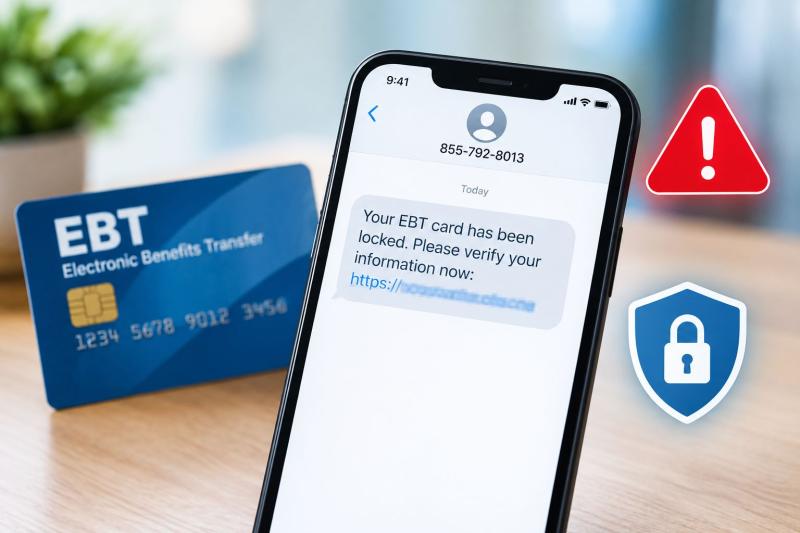
The VDSS EBT text message scam involves suspicious messages that claim an EBT card has been locked, deactivated, or affected by an unfamiliar transaction. These messages may display the Omnilert SMS shortcode 70359, mention JPMorgan Chase, or direct recipients to call 855-792-8013.
Although the Virginia Department of Social Services (VDSS), Omnilert, and JPMorgan Chase are legitimate organizations, scammers may misuse their names or spoof a legitimate shortcode to make suspicious messages appear trustworthy. The main concern is that these messages may attempt to steal EBT card numbers and PINs.
The VDSS EBT text message scam involves messages that may mislead recipients into believing there is a problem with their EBT cards or benefits. Some messages claim that a card has been locked or deactivated and instruct the recipient to take action to restore access.
Other messages refer to transactions that recipients may not recognize. These transaction descriptions can make the recipient concerned about possible unauthorized activity and encourage them to respond to the message.
The messages may direct recipients to a website or telephone number (such as fake 1-866 numbers or numbers ending in 0486) to "unlock" or "verify" your account, to reactivate their cards, resolve an alleged transaction, or provide card information. The objective of these phishing attempts is to obtain sensitive details, including the EBT card's 16-digit number and PIN.
According to the supplied information, VDSS does not send text messages about suspicious EBT transactions. Therefore, a message claiming to report such a transaction should not be trusted simply because it mentions VDSS or uses an official looking sender identification.
There are several variations of the exact same EBT phishing scam. While they use different sender names and phone numbers to confuse people, their underlying goal, setup, and execution are identical. Few examples of these scam messages are:
Example 1:
"JPMorgan Alert
JPMorgan Chase: A transaction of $34.15 at WM-Store using your EBT card was declined.
Reply Y if this was you. If not, call: +1(855)792-8013"
Example 2:
"Omnilert VDSS EBT: A Order of $44.15 at Walmart using your EBT Card was declined. Reply Y if this was you. If not, call: 1-866-202-4567 "
Example 3:
"Omnilert VDSS EBT: A Transaction of $37.18 at WM using your EBT Card was declined. Reply Y if this was you. If not, to speak... more [link removed for safety]"
Example 4:
"VDSS EBT – A transaction of $34.15 at W-STR using your EBT Card was declined. Reply Y if this was you. If not, to speak to a representative, call: +1(866)202-4567."
Example 5:
"ALERT: Your Virginia EBT card has been temporarily locked due to unusual activity. To instantly unlock your card and avoid losing benefits, please click here: [Link Removed for Safety] or call immediately."
Example 6:
"VDSS Promotion: Families receiving SNAP benefits qualify for a free government smartphone. Click here to upload a photo of your EBT card and verify your PIN to claim your free device."
Example 7:
"VA EBT: Your account requires immediate activation. Please call the VDSS Client Customer Service Helpdesk to activate your EBT account now."
The supplied information identifies 855-792-8013 as a number associated with EBT phishing.
Messages associated with this number may claim that an EBT card has been locked or deactivated. They may direct recipients to a website or telephone number to reactivate the card or resolve the supposed problem.
These requests may be designed to collect the recipient's EBT card number and PIN. The information obtained could then be used to compromise the card and drain its available benefits.
Other phone numbers mentioned in the supplied information include:
These numbers appear in the context of suspicious EBT messages. Recipients should avoid relying on contact details supplied in unexpected messages and should use the official EBT support information instead.
The Virginia Department of Social Services (VDSS) is a legitimate government agency within the Commonwealth of Virginia. It administers and supports public assistance programs, including SNAP, Medicaid, Temporary Assistance for Needy Families (TANF), and child protective services.
Scammers may impersonate VDSS because people receiving public benefits have a strong reason to pay attention to messages about their accounts. But, the existence of a fraudulent message does not mean the real agency is involved.
Omnilert is a highly reputable, cloud based emergency mass notification platform. It is widely used by colleges, universities, large corporations, and hospitals to blast out urgent, life saving information, such as active shooter alerts or severe weather updates, via text message, phone call, and email. The 5-digit number 70359 is the official SMS text messaging shortcode registered to and used by Omnilert to send out these broadcast alerts.
However, the reason you received a scam text from a legitimate number is due to a tactic known as spoofing or malicious gateway abuse.
Scammers are abusing or spoofing the shortcode 70359 to push out fraudulent mass texts. The text falsely claims that your EBT transaction was declined or that unusual/suspicious activity was detected on your card. A common script reads:
"VDSS EBT – A transaction of $34.15 at W-STR using your EBT Card was declined. Reply Y if this was you. If not, call +1(866)202-4567."
If you call the number provided in the text, an automated recording will pretend to be "VA EBT" and instruct you to enter your 16-digit card number and your PIN. Once you do, the scammers steal your credentials and immediately drain your benefits.
JPMorgan Chase is a legitimate financial institution. However, its name appearing in an EBT text message does not prove that the message came from the bank or that the reported transaction actually occurred.
The reported message claims that a $34.15 transaction at "WM-Store" was declined and tells the recipient to call 855-792-8013 if they do not recognize it.
This resembles the VDSS/Omnilert variation in its wording and purpose, but uses a different organization name and callback number. The supplied information describes the two variations as part of a related phishing campaign. However, the similar wording alone does not independently prove that both messages came from the same operators.
The important point is that scammers can impersonate different organizations to reach the same goal: obtaining your EBT card number and PIN.
Caller ID Spoofing:
Highly sophisticated scammers use software to mimic or "mask" their real phone number. They can manipulate the networks so that the text message falsely displays "70359" on your phone, making it look like it came from Omnilert when it actually originated from an offshore server.
Account Compromise / Trial Abuse:
In some cases, scammers find a loophole or compromise a legitimate sub-account on mass communication platforms to push out a batch of phishing messages before the company detects and shuts them down.
Even if a text message appears to come from a real, trusted shortcode like Omnilert's 70359, always look at the "call to action."
Omnilert is a software delivery system; it has no business or legal connection to your Virginia EBT account. If the message tells you to click an unfamiliar link or dial a phone number that does not match the official government hotline (1-866-281-2448), it is an absolute trap.
There are several variations of the exact same EBT phishing scam. While they use different sender names and phone numbers to confuse people, their underlying goal, setup, and execution are identical.
In fact, the JPMorgan Chase variation mentioned in below is actually a subset of the VDSS/Omnilert scam campaign.
"JPMorgan Alert
JPMorgan Chase: A transaction of $34.15 at WM-Store using your EBT card was declined.
Reply Y if this was you. If not, call: +1(855)792-8013"
The supplied information identifies several steps recipients can take if they receive a suspicious EBT message or believe their card information may have been exposed.
Check website links carefully:
The real agency will direct you to official websites ending in .gov. Scammers may use similar looking links ending in .com, .net, or random text strings to mislead you.
Do Not Reply to Suspicious Messages:
Do not reply to suspicious texts, click their links, call the numbers they provide, or share your EBT card number or PIN in response to their instructions.
Use the Official ConnectEBT Service:
Use the official ConnectEBT app or online portal to access and manage your EBT account rather than following a link in an unexpected message.
Lock Your EBT Card:
Use the available card-lock feature to lock your card if you are concerned about unauthorized access.
Change Your PIN:
If your PIN may have been exposed, change it through the official app or by contacting the helpline listed on the back of your EBT card.
Contact the Official Virginia EBT Helpdesk:
The official Virginia EBT Customer Service Helpdesk is available at 1-866-281-2448 (available 24/7).
You can also contact the appropriate state EBT office or local SNAP office for assistance.
If you ever need to apply for benefits safely or check your real case status, always use the secure official state portal at Virginia CommonHelp.
Report the Incident:
The supplied information identifies the VDSS reporting portal, the relevant state EBT or SNAP office, local police, and the Federal Trade Commission (FTC) as reporting options.
If your EBT card has been compromised, contact the appropriate EBT service or state office about reporting the incident and requesting a replacement card.
The VDSS EBT text messages associated with 855-792-8013, Omnilert 70359, and JPMorgan Chase raise concerns about EBT phishing. These messages may claim that an EBT card transaction was declined, that the card has been temporarily locked, or that immediate action is required to restore access.
Although VDSS, Omnilert, and JPMorgan Chase are legitimate organizations, their names or a legitimate SMS shortcode 70359 appearing in a message do not establish that the message is genuine.
The messages may attempt to obtain your 16-digit EBT card number and PIN. Do not reply to suspicious messages, click their links, or call the numbers provided in them. Instead, use the official ConnectEBT app or online portal to manage your account and contact the Virginia EBT Customer Service Helpdesk at 1-866-281-2448 (available 24/7).
The information in this article is provided for educational and awareness purposes. Company names, phone numbers, sender names, and other details referenced may have been impersonated, spoofed, or otherwise misused by scammers. Their appearance in this article does not necessarily identify the legitimate company, owner of a phone number or account as being involved in fraudulent activity.
This article has been written by a Scam Fighter Contributor, De-Reviews.com Team. If you believe the article above contains inaccuracies or needs to include relevant information, please contact ScamAdviser.com using this form.
De-Reviews.com Team is a group of scam researchers, editors, and online safety advocates dedicated to exposing online fraud and helping consumers stay safe online. The team has been investigating scams, fraudulent websites, phishing campaigns, and other online threats since 2014. Read the Full Author Profile.
