
EN
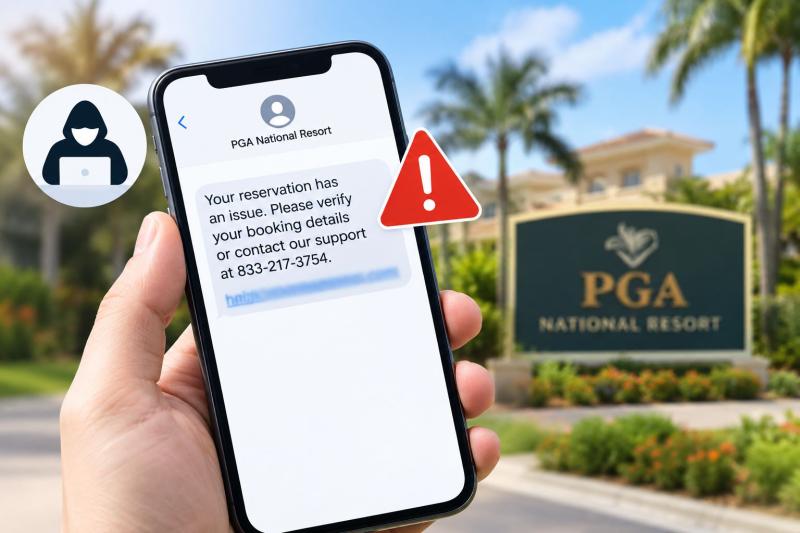
The PGA National Resort text message scam involves fraudulent messages that claim there is a problem with a hotel reservation and ask guests to verify their booking, update payment details, or contact customer support. One reported message directs recipients to the fake customer service telephone number like 833-217-3754 for assistance with a supposed reservation issue.
These messages may use real booking details to appear genuine, but they should be treated with caution. PGA National Resort is a legitimate resort, and the warning concerns fraudulent messages impersonating the resort.
This type of phishing attempt targets people who have made hotel or resort reservations. The message may claim that a booking is pending, that a payment has failed, or that a reservation will be canceled unless the recipient takes immediate action.
Scammers may send these messages through SMS text messages, WhatsApp, or other messaging platforms. They often include a link to a website that looks like a hotel reservation page or provide a phone number supposedly belonging to a customer support department.
The goal is to persuade recipients to share sensitive information, such as credit card numbers, billing details, passwords, or other personal information. Some fraudulent websites may also attempt to collect a payment under the pretense of confirming an existing reservation.
One reason this type of message can be convincing is that it may include a person's real name, check-in date, checkout date, or booking confirmation number. However, knowing these details does not mean that a message is legitimate.
PGA National Resort is a legitimate hospitality business. Scammers can impersonate legitimate hotels, airlines, delivery companies, banks, and other organizations to make fraudulent communications appear trustworthy. They may also use information connected to real transactions to make their messages more convincing.
The important distinction is between the legitimate resort and an unverified message claiming to represent it. A message that asks you to visit an unfamiliar website, call an unverified number, or provide payment information should be checked independently before you take any action.
A suspicious message may look similar to the following example:
"PGA National Resort: Hi Renee, your reservation is confirmed.
Confirmation: PGA-2026-RALPAE
Check-in: Fri, Oct 23, 2026
Check-out: Sun, Oct 25, 2026
Total Charged: $1,245.00
To modify or cancel your reservation, visit the link provided in this message."
The example above illustrates how a fraudulent message may use realistic booking information to gain the recipient's trust. The name, confirmation number, dates, and amount are illustrative details and should not be treated as evidence of an actual booking.
A related reported message directs recipients to fake customer service telephone number like 833-217-3754 or a reservation related website to address a supposed booking problem. Simply because the message includes the resort's name, we cannot assume that the phone number or website is affiliated with PGA National Resort.
These types of messages use urgency, uncertainty, and the fear of losing a reservation to encourage people to act without checking whether the request is genuine.
Scammers use several tactics to make fraudulent reservation messages look authentic.
Some hotel reservation phishing campaigns appear to involve access to guest booking information. This information may be obtained through compromised accounts, third party booking systems, data leaks, or other unauthorized access. However, the source of the information in any particular message may not be known.
If a message contains your actual name, travel dates, or confirmation number, you may naturally assume it came from the resort. Scammers exploit this trust to make their requests more believable.
A message may warn that your reservation will be canceled within 24 hours unless you verify your payment details. It may also claim that your booking is pending or that your card has been declined.
These warnings are designed to make you worry about losing your reservation. When people feel pressured, they may be less likely to check the sender, inspect the link, or contact the resort independently.
The message may contain a link to a website that imitates a hotel booking or payment page. A website can display a resort's name, logo, booking dates, and confirmation information without being operated by the resort. A professional appearance is not proof that a website is safe.
If you enter your payment information on a fraudulent page, the operators may use it for unauthorized transactions or other financial fraud.
Instead of asking you to visit a website, scammers may tell you to call a support number such as 833-217-3754 to resolve a booking issue.
A person answering the call may claim to be a reservation agent and ask you to confirm your identity, provide card details, make another payment, or share a verification code.
Do not assume a phone number is legitimate because it uses a toll-free prefix or because the person answering knows your booking details. Verify the number independently through the resort's official website or your original booking confirmation.
A message about a pending reservation can be particularly effective when someone has already paid for a hotel stay or is preparing for an upcoming trip.
Scammers may claim that an additional deposit is required, that a payment must be repeated, or that a reservation cannot be held without immediate action. Their objective is to get you to pay or disclose sensitive information before you have time to verify the request.
Not every unexpected reservation message is fraudulent, but several warning signs should prompt you to investigate before responding.
Remember that good spelling, correct personal information, and a convincing booking reference do not guarantee that a message is genuine. The safest approach is to verify the request independently.
If you receive a suspicious message about a reservation, take the following steps to protect yourself:
Avoid opening links, calling the supplied number, replying to the sender, or providing any personal or financial information. In particular, do not use the number 833-217-3754 to verify the message without independently confirming that it belongs to the resort.
Interacting with a suspicious message may expose you to phishing attempts or encourage further unwanted contact.
Visit PGA National Resort's official website by entering its address yourself or use the contact details in your original booking confirmation. You can also check your reservation through the official booking platform you used.
Ask the resort whether there is actually a payment problem, verification request, or change to your reservation. Do not rely on the contact information supplied in the suspicious message.
A suspicious message may ask you to enter your credit card number, security code, account password, or a one-time verification code.
Do not provide these details through an unverified website or to an unverified caller. If a payment genuinely needs attention, resolve it through a trusted booking channel.
In the United States, you can forward unwanted or suspicious text messages to 7726 (SPAM). This helps your mobile carrier review the message.
You can also report suspected fraud to the Federal Trade Commission (FTC) at ReportFraud.ftc.gov. If the message came through WhatsApp or another messaging service, use its reporting tools as well.
Keep a screenshot of the message, the sender's number, the suspicious link, and any related communication if you need to report the incident.
If you entered your card details, made a payment, or disclosed banking information through a suspicious link or call, contact your bank or card issuer immediately.
Ask the provider to review the situation, block or replace the affected card if necessary, and monitor for unauthorized transactions. If you reused a password on the suspicious website, change it on the affected account and any other accounts where you used the same password.
If you shared a one-time verification code, contact the relevant financial institution or account provider promptly because the code may have been used to authorize access or a transaction.
Check your bank and credit card statements for unfamiliar charges. Review your hotel booking through the official channel and contact the resort if you notice an unexpected change.
If you suspect that your reservation account or email account has been compromised, change the relevant passwords, enable multifactor authentication where available, and review recent account activity.
Receiving a message with your correct name, booking number, or travel dates can be alarming. It may also make the message appear more trustworthy than a generic phishing attempt.
However, real reservation details do not always mean that the sender is legitimate. Information can be exposed through compromised accounts, third party services, data breaches, or other sources.
If the message contains accurate booking information, take these precautions:
You can also ask the resort or booking platform whether it has identified any suspicious activity affecting your reservation.
The PGA National Resort text message scam is a warning about fraudulent communications that impersonate a legitimate resort to obtain money or personal information. Messages involving fake customer service telephone number such as 833-217-3754, unfamiliar reservation links, urgent payment requests, or threats of cancellation should be treated with caution and verified independently.
These messages can be convincing, especially when they contain real guest names, booking dates, or confirmation numbers. However, such details do not prove that the sender is authorized to handle your reservation.
Do not click suspicious links, call unverified numbers, or provide payment information in response to unexpected messages. Confirm any booking issue directly through official channels, report suspicious texts, and contact your bank immediately if you have shared financial details.
The information in this article is provided for educational and awareness purposes. Company names, phone numbers, sender names, and other details referenced may have been impersonated, spoofed, or otherwise misused by scammers. Their appearance in this article does not necessarily identify the legitimate company, owner of a phone number or account as being involved in fraudulent activity.
This article has been written by a Scam Fighter Contributor, De-Reviews.com Team. If you believe the article above contains inaccuracies or needs to include relevant information, please contact ScamAdviser.com using this form.
De-Reviews.com Team is a group of scam researchers, editors, and online safety advocates dedicated to exposing online fraud and helping consumers stay safe online. The team has been investigating scams, fraudulent websites, phishing campaigns, and other online threats since 2014. Read the Full Author Profile.
