
EN
Update: This article was last reviewed and updated in August 2026 to ensure the information reflects current scam trends and online safety best practices.
Today, the most dangerous scam websites don’t look like scam websites. They look exactly like the real thing. AI-generated content, stolen brand assets, and fake trust seals mean the old advice, “just look for bad grammar”, no longer works.
According to the Global Anti-Scam Alliance, 57% of adults globally were scammed last year, yet 73% believed they could spot a scam. The gap between confidence and reality is exactly what fraudsters exploit. This guide closes that gap.
In a Nutshell
Scammers now use AI tools to generate flawless website copy, realistic product images, convincing customer testimonials, and even chatbot “support agents.” Traditional red flags like poor spelling, broken English, and generic stock photos no longer apply to the most sophisticated scam operations.
What hasn’t changed: the underlying structure of how scam sites operate. The 10 red flags in this guide focus on verifiable facts, domain age, payment methods, independent reviews, legal registration — that AI cannot fake. Use these, not surface aesthetics.
There are several ways you can tell if a website is a scam. Here are some of them.
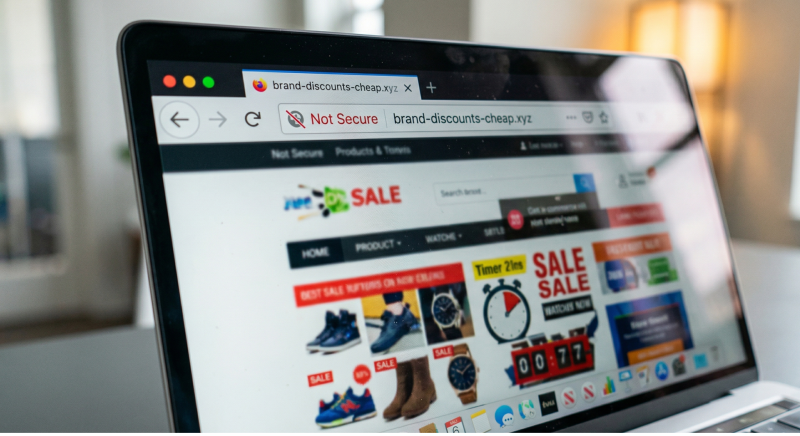
A Gucci bag at 80% off. A new iPhone for half the retail price. A luxury watch for $29. If a deal defies logic, trust that instinct. Scammers deliberately price products far below market value to override scepticism. Legitimate premium brands almost never discount at these levels, and no real business can sustainably sell at a loss.
This is the oldest trick in the book, and it still works because greed is a powerful override. Don’t let a great price cloud your judgement. When in doubt, step away.
Tip: Check the same product on 2–3 trusted retailers. If the price gap is enormous, the site is almost certainly fake.
Most legitimate online businesses have active, engaged social media accounts. Scam sites often insert social media icons but the links either go nowhere, lead to the website homepage, or point to empty or newly created profiles. Scammers are often too lazy, or too strategic, to build real social accounts. A real presence invites real complaints.
Look at follower count, post history, and whether real people are engaging with the content, not just bots. A profile created last month with 12 posts and no comments is a red flag even if the link works.
Tip: Click every social media icon on the site. If any are broken, empty, or lead to profiles created in the last 3 months, treat it as a serious warning.
A reviews section on a website is easy to fabricate. Names, photos, and testimonials can all be generated by AI or copied from other sites in seconds. What scammers cannot fake is an independent third-party review platform. If a site has glowing on-site reviews but zero presence on Trustpilot, Google Reviews, or Sitejabber, that absence is a red flag.
Equally, a Trustpilot profile with 500 five-star reviews posted in a single week is suspicious. Genuine review profiles accumulate gradually, include mixed feedback, and show the company responding to complaints. If you find angry users warning others in the reviews, believe them.
Tip: Search the company name + “reviews” or “scam” on Google. Check Trustpilot, Sitejabber, and the BBB independently, don’t rely on links on the site itself.
Scammers register domains that look legitimate at a glance but contain subtle differences: amazon-secure.io, paypa1.com, microsoft-login.net. This technique is called typosquatting or domain spoofing. Also watch for unusual TLDs (.xyz, .top, .click, .shop) which are statistically disproportionately used by fraudulent sites.
Always read a domain right to left from the first forward slash, amazon.com.verify-update.io is NOT Amazon. The real domain is verify-update.io.
Tip: Always type the URL manually or use a bookmark. Never navigate to a financial site via a link in an email or social media post.
Legitimate businesses accept credit cards, PayPal, or other consumer-protected payment methods because they expect to fulfil their orders. Scammers avoid these because chargebacks would expose them. If a site insists on bank wire transfer, cryptocurrency, Western Union, MoneyGram, or gift cards, walk away immediately.
Payment methods like Western Union, MoneyGram, Skrill, and Bitcoin are often untraceable, and it is virtually impossible to recover money sent via these methods. They are favoured by scammers for exactly that reason.
Tip: Use a credit card wherever possible as it gives you chargeback rights if goods are not delivered. Never wire money to a retailer you haven’t independently verified.
Legitimate businesses want to be contactable. Scam sites hide. Check for a physical address (not a PO Box or mail forwarding service), a real phone number (call it), and a branded email address (not Gmail, Yahoo, or Hotmail). If the only contact option is a web form with no other details, that is a significant red flag.
A professional business usually replies to emails within hours, or at most two working days. If no one answers a phone call and no one replies to an email, that tells you everything you need to know.
Tip: Copy the physical address into Google Maps. If it doesn’t correspond to a real business premises, not a parking lot or a residential address, proceed with extreme caution.
A lot of fraudulent web shops combine trusted brand names (Nike, Apple, Chanel, Amazon) with discount keywords to appear in search results. The product page might look authentic, correct logo, professional photos often stolen from the brand’s own site, but the URL, contact details, and payment process reveal the truth.
Premium brands rarely or never put their products on sale at significant discounts, and they do not sell through unknown third-party discount websites. Most serious online stores also sell multiple brands, a site that sells only Gucci or only Nike at 70% off should immediately raise suspicion.
Tip: Check if the brand has an official list of authorised resellers on its own website. If the site you’re looking at isn’t on it, don’t buy.
Countdown timers. “Only 2 left in stock!” “Offer expires in 10 minutes.” “Your account will be deleted unless you act now.” Pressure is a manipulation tool designed to override your critical thinking. Legitimate businesses rarely need to create artificial panic to make a sale.
Urgency is the scammer’s most reliable weapon. It works by stopping you from doing the one thing that would expose the scam: slowing down and researching. Any website or message that demands immediate action deserves the most scepticism.
Tip: Pause, research, and verify before doing anything. If the deal disappears because you took 10 minutes to check, it was never a real deal.
Every legitimate online store is legally required to have a Privacy Policy, Terms & Conditions, and a Returns Policy. Scam sites often omit these entirely, use placeholder text, or copy-paste boilerplate that doesn’t match their business. Ask yourself: would a real business put up incomplete or sloppy text?
Look specifically at the returns policy. If it requires you to ship goods back at your own expense to an address in a country with weak consumer protection laws, that is a deliberate trap designed to make recourse impossible.
Tip: Google exact phrases from the site’s Privacy Policy or T&Cs. If the same text appears on dozens of other unrelated sites, it’s plagiarized boilerplate, a reliable sign of a scam.
Most scam sites exist for a few months before disappearing with their victims’ money. This means the domain was registered very recently. You can check any site’s registration date for free using a WHOIS lookup tool (whois.domaintools.com or simply search “whois [domain]”). Domain names registered for short periods are also suspicious — scammers don’t invest much in their operations.
A domain registered in the last 3–6 months, combined with any of the other warning signs on this list, significantly raises the risk level.
Tip: Use ScamAdviser.com — it automatically checks domain age as one of its 40+ trust signals and displays it clearly.
Before making any purchase from an unfamiliar website, run through this checklist:
Still not sure? Don’t do it. If you are still unsure after checking, it’s better to be cautious and follow your instinct. There are plenty of other shops to buy from. A great price is not worth losing your money or your personal data.
Your choice of payment method is your last line of financial defence:
Payment Method Consumer Protection Verdict Credit Card Chargeback rights if goods not received or misrepresented. Strong fraud protection. ✅ Safest option PayPal / Klarna Buyer protection on eligible purchases. Dispute resolution available. ✅ Safe Apple Pay / Google Pay Backed by card payment protection. Tokenised — card details not shared with merchant. ✅ Safe Debit Card Some chargeback rights but weaker than credit card. Money leaves account immediately. 🟡 Use with caution Bank Transfer / IBAN No chargeback. Once sent, virtually impossible to recover. 🔴 Avoid on unknown sites Cryptocurrency Fully irreversible. Anonymous. No consumer protection. Scammers’ preferred method. 🔴 Never for retail purchases Gift Cards Untraceable. Irreversible. Used exclusively by scammers for payment. 🔴 Always a scam signal Western Union / MoneyGram No fraud protection. Designed for person-to-person transfers, not retail. 🔴 Always a scam signalSeveral tools are available online to help you verify websites, check images, confirm business registration, and investigate phone numbers. Use them before you buy.
Legitimate businesses are registered with their country’s relevant regulatory authority. If a business claims to be based in a specific country, verify it:
This may not always be easy when buying across borders, but if a company claims a specific jurisdiction, you can check whether it’s actually registered there.
As AI improves, deepfake videos are becoming easier to create and harder to detect. They have been used in high-profile investment and romance scams.
Deepware (deepware.ai) — scan a suspicious video to find out if it has been synthetically manipulated.
Act fast, the first 24–48 hours are critical for recovering money or limiting damage:
Frequently Asked Questions
How can I tell if a website is a scam?
Check the URL with ScamAdviser and verify domain age, independent reviews, real contact details, and secure payment methods rather than relying on grammar or design.
Does HTTPS mean a website is safe?
No, HTTPS only encrypts the connection and does not guarantee the website itself is legitimate.
What payment method is safest for online shopping?
Credit cards are the safest because they offer chargeback protection, while PayPal also provides buyer protection on eligible purchases.
Can I trust a website that has a trust seal or security badge?
Not always, fake seals are common, so you should click the badge to confirm it links to a real verification page.
Still not sure whether a site is legitimate?
If you’re unsure after checking, it’s safest to avoid the site and shop from a verified retailer instead.
Over 4.5 million consumers use ScamAdviser every month to check websites before they shop, share data, or invest. Paste any URL into ScamAdviser.com for an instant risk assessment powered by 40+ independent data sources.
If you’ve encountered a scam site that isn’t yet flagged, report it at ScamAdviser.com/report-a-scam. Every report protects millions of other consumers.
See More Interesting articles from ScamAdviser:
