
EN
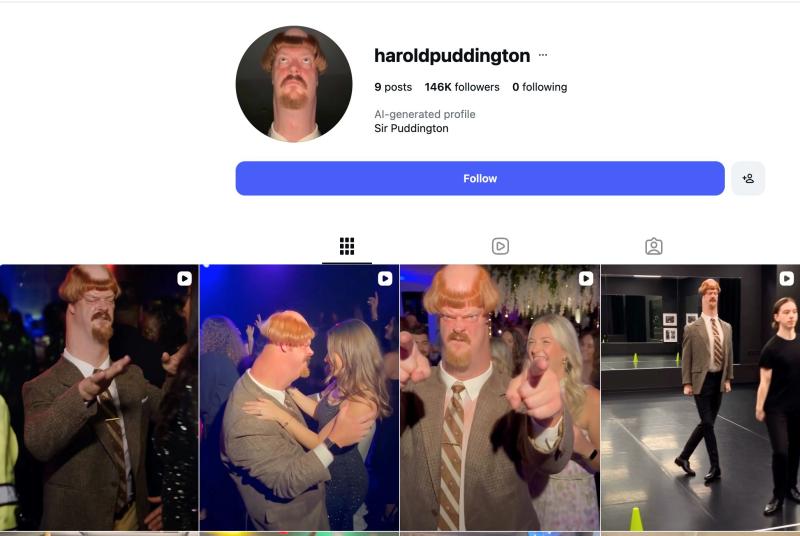
Social media platforms are currently filled with videos of an elderly man with an unusual appearance. Known online as "Harold Puddington" or "Sir Puddington", this character appears in short clips dancing at crowded parties, posing with friends, and moving in everyday environments.
Because the videos look highly realistic at first glance, millions of viewers are left asking a simple question: Is Harold Puddington a real person, or is he fake?
Here are the facts behind this viral online mystery.
Harold Puddington is presented on platforms like Instagram and YouTube as an older man enjoying a lively social life. The character has quickly gone viral due to a very distinctive appearance, characterized by an unusually long neck, a unique hairstyle, and exaggerated facial proportions.
Dedicated social media profiles, such as the Instagram account @haroldpuddington, share regular updates of the character's fictional life. These videos often show him showing off complex dance moves in clubs or interacting with crowds of people.
The short answer is: Harold Puddington is completely AI generated, not real. He is a digitally created, AI-generated persona.
There is no independent, real-world evidence or official record establishing a conventional human identity behind the name or the face. In fact, the account creator openly states in the official profile bio that it is an "AI-generated profile". While the videos are designed to look like real mobile phone footage, the person shown in them does not exist in the real world.
Publicly available evidence shows that the character is the product of advanced generative artificial intelligence (AI) tools.
Instead of altering the photo of a living person, digital creators use text-to-image and text-to-video AI models to build characters entirely from scratch. Software tools generate the character’s facial features, skin textures, and clothing, and then animate those elements to simulate human movement.
By applying strict instructions to the AI software, the creators are able to maintain digital consistency. This means the character keeps the exact same face, head shape, and long neck across many different simulated videos and settings.
The rise of profiles like "Sir Puddington" highlights how advanced digital generation tools have become. While this specific account is used for entertainment and digital art purposes, it serves as a reminder for internet users to remain cautious online.
When evaluating whether an online profile represents a real human, look for these common signs of AI generation:
Physical Anomalies:
Look for unnatural body proportions, such as limbs or necks that look mathematically impossible.
Unusual Textures:
AI video generators often struggle with rendering perfectly consistent hair strands, realistic eye reflections, or details in background crowds.
Lack of Real World History about Harold Puddington:
AI generated digital identities typically lack an authentic trail of real world history, media appearances, or verifiable personal background outside of their immediate social media loop.
Ultimately, Harold Puddington is a fascinating demonstration of modern digital art. He is a highly visible reminder that today, the most popular faces on your social media feed might be the ones that never existed at all.
Based on all available evidence and the account creator's own public admission, the final verdict is that Harold Puddington is AI-generated. The profile does not represent a real human being. Instead, it operates strictly as an entertainment project and a demonstration of modern digital art.
While the account itself does not appear to be malicious, it serves as a powerful reminder of how easily advanced technology can create convincing digital personas. Consumers should always verify profile descriptions, look for physical anomalies, and check for real-world history before trusting online identities.
Image Source: Screenshot taken from the official Instagram profile of Harold Puddington (Sir Puddington)
The information provided in this article is intended solely for general consumer awareness, educational purposes, and media literacy analysis. The analysis is based on publicly available data, open-source documentation, and explicit disclosures made directly on the social media profiles referenced.
This article neither promotes nor condemns the referenced profile, its creators, or the use of generative artificial intelligence technology. The content is presented strictly as a neutral, fact-based review for public information and does not seek to endorse, advertise, or criticize the digital art project or the platforms hosting it.
This article contains a screenshot of a public social media platform interface. The use of this media is intended for non-commercial commentary, criticism, news reporting, and educational instruction regarding digital identity verification, which qualifies as "fair use" under applicable copyright laws.
All trademarks, brand names, and copyrights belong to their respective owners.
The findings presented here are entirely objective and based on facts disclosed by the account operators themselves. This review does not imply or allege fraudulent intent, malicious behavior, or scam operations by the creators of the profile, who explicitly label the content as an entertainment and digital art project.
This article has been written by a Scam Fighter Contributor, De-Reviews.com Team. If you believe the article above contains inaccuracies or needs to include relevant information, please contact ScamAdviser.com using this form.
De-Reviews.com Team is a group of scam researchers, editors, and online safety advocates dedicated to exposing online fraud and helping consumers stay safe online. The team has been investigating scams, fraudulent websites, phishing campaigns, and other online threats since 2014. Read the Full Author Profile.
