
EN
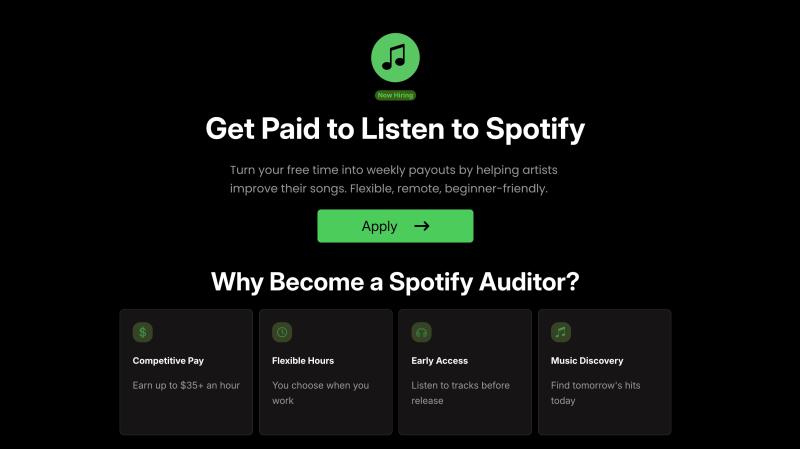
Online offers promising easy money tend to attract a lot of attention, especially when they involve something people already enjoy doing. Recently, many users have reported seeing promotions claiming they can get paid to listen to Spotify music through third party websites. These offers frequently advertise earnings such as $35, $36, $45, etc. per hour, with some claims going as far as $393 per day simply for listening to songs or playlists and reviewing them.
Third party websites like Songcheckus.com and Spfyapply.com are often mentioned in these promotions. They present themselves as application platforms where users can supposedly sign up to become paid Spotify listeners. While this idea sounds appealing, it’s important to carefully examine how these programs work and whether the claims hold up under closer review.
These opportunities are heavily marketed across multiple channels. Users commonly encounter them through:
The messaging is usually straightforward and enticing: listen to music, complete simple tasks, and earn a high hourly rate without special skills or experience. This type of promotion is designed to attract a wide audience, including students, part time workers, and people looking for remote income options.
Most of these third party platforms follow a similar pattern. They claim that users can:
However, when reviewing the details closely, users often notice that clear explanations of the actual work, payment structure, or verification process are missing or vague.
One key point often overlooked is that these websites are not officially connected to Spotify. Spotify operates as a music streaming platform that pays artists and rights holders based on streams, not listeners.
There is no publicly announced or verified program from Spotify that pays everyday users to listen to music for personal earnings. Any website suggesting otherwise relies on third party explanations rather than official confirmation.
Many users report that after registering on sites like Songcheckus.com or Spfyapply.com, they are redirected through multiple websites. Instead of immediately earning money, they are often asked to:
In many cases, users never reach a clear dashboard showing real earnings or a reliable withdrawal method. The focus appears to shift from music listening to completing various external steps.
Earning $35, $36, $45, etc. per hour or $393 per day for a simple activity like listening to music is unusually high when compared to legitimate online microtask or survey platforms. Real digital work opportunities typically require time, skill, or specialized input to justify that level of pay.
When income figures are highlighted more prominently than the actual process, it’s often a sign that the offer relies more on marketing appeal than realistic outcomes.
Rather than providing paid listening jobs, these platforms often seem structured to achieve other objectives, such as:
In these situations, users contribute value through clicks, sign-ups, and engagement, while direct financial compensation remains unclear or nonexistent.
When evaluating similar offers, users should pay attention to the following indicators:
These signs do not necessarily indicate a legitimate job opportunity and should encourage further research before participation.
The idea of earning $35, $36, $45, etc. per hour or even $393 per day by listening to Spotify music through websites like Songcheckus.com or Spfyapply.com may sound appealing. However, when examined carefully, these offers rely heavily on promotional language while providing limited evidence of real, consistent payouts.
Before engaging with similar programs, users should verify official partnerships, read independent reviews, and remain cautious of claims that promise high income for minimal effort. Taking time to research can help avoid disappointment and protect personal information online.
Disclaimer: This article has been written by a Scam Fighter Contributor. If you believe the article above contains inaccuracies or needs to include relevant information, please contact ScamAdviser.com using this form.
