
EN
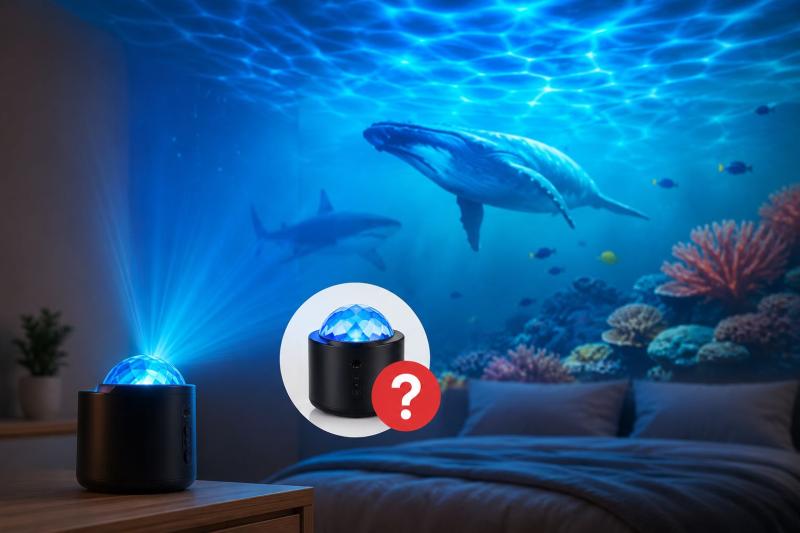
We can see that the Viral Ocean Projector has been widely promoted on TikTok, Instagram, and other social media platforms. Advertisements show small projectors turning ordinary bedrooms into colorful underwater worlds, with moving ocean waves, galaxies, whales, sharks, coral reefs, and bright images covering walls and ceilings.
But can a small budget projector really do all that? This article looks at what these projectors can realistically do, what users have reported, and why some online advertisements may create expectations that the actual product cannot meet.
The Viral Ocean Projector generally refers to a range of inexpensive LED or disc based ambient lights sold through different online stores. Many versions cost around $15 to $30, although some discount websites may offer them for less, while some may offer for slightly more price.
Most basic versions use USB power and a rotating light or disc system to create moving water like patterns and changing colors on a wall or ceiling. Some models include a remote control with options for brightness, color, and movement speed. Certain versions offer up to 16 colors.
More expensive disc insertion models may create more detailed scenes, but a basic budget unit should not be confused with a full home theater projector.
Yes, to a point. The rotating projection system can create moving colored patterns that resemble water ripples or waves. Some users report that they find the movement acceptable, especially in a completely dark bedroom.
The effect can produce an ambient lighting effect for sleeping, meditation, or general room use. Some people may also use it in children's rooms, gaming spaces, or as a background for content creation.
However, there is an important difference between moving water like light and a realistic underwater impression. A standard low cost unit normally produces repeating patterns of colored light. It generally does not create the detailed, high definition underwater scenes as shown in some social media clips.
Advertisements can make it look like that a tiny device on a bedside table can cover an entire room with dramatic underwater visuals. User reports suggest that the real projection can be much smaller.
Some users report acceptable coverage in small bedrooms when they place the device correctly. Others report that the projected area covers only a relatively small section of a wall or ceiling, with some complaints describing coverage of roughly 3 to 4 feet.
The actual size depends on the distance from the projector, room size, placement, wall and ceiling conditions, and surrounding light. A small bedroom may therefore produce a better result than a large living room.
This is another area where marketing and reality may differ. Some promotional videos show crystal clear underwater scenes, realistic waves, colorful galaxies, and detailed visuals that look almost like a miniature planetarium.
But, customer experiences are more mixed. Some users report that the colors are acceptable and that the projection works in a dark room. Others say the image looks blurry, soft, cartoon like, or much less detailed than the promotional material.
Some buyers even compare the result to a basic children's nightlight rather than a cinematic underwater experience. It simply means the actual result may not match what some advertisements suggest.
Some versions advertise adjustable focus. This can help users improve image clarity depending on the projector's position and distance from the wall or ceiling.
However, user feedback suggests that the results vary. Some owners improve the picture after adjusting the focus, while others still find the image softer than expected. Therefore, a focus adjustment should not be treated as a guarantee of sharp, high definition visuals.
Consumers should be especially careful with advertisements showing highly realistic 3D underwater scenes. Some viral videos show whales, sharks, coral reefs, ocean sunlight, and other detailed images moving across a ceiling.
A basic $15 to $30 ocean wave light normally does not have the hardware needed to play high definition video content like a proper smart projector. Instead, it generally creates repeating light patterns. Some more advanced disc based models may offer more detailed images, so buyers should check the exact specifications of the model being sold.
Yes, and this is an important fact check point. Online advertisements can use professional cameras, carefully controlled lighting, video editing, green screen effects, CGI, stock footage, or AI-generated visuals.
For example, an advertisement might show high quality underwater footage appearing across a bedroom ceiling and make it seem as though the small projector created the entire scene.
Another possibility is a projector swap. A tiny ambient projector may sit beside a bed while a much more powerful home theater projector connected to a laptop creates the large underwater image.
These techniques can make a budget light appear brighter, sharper, and more powerful than it normally looks in everyday use. Consumers should therefore judge the actual hardware rather than relying only on viral demonstrations.
The final result can change significantly depending on the environment.
Important factors include:
A small room with white walls and very little light will usually provide better conditions than a large room with colored walls and bright lighting. Professional promotional videos also use carefully selected conditions that may not match an ordinary bedroom.
This is one claim that seems realistic. Most versions use simple USB plug and play operation. Users can normally connect the cable to a power source, place the device where they want it, and switch it on.
There is usually no complicated Wi-Fi setup, account, or app required. Many versions include a remote control for changing colors, brightness, and movement speed.
The motor also looks reasonably quiet according to many users’ reports, making the device suitable for nighttime use.
The low price can also mean basic construction. Many versions seems to use lightweight plastic or acrylic parts. Some users describe them as feeling inexpensive or just like a toy.
There are also publicly available complaints about durability. Some reports mention problems with the cord or spinning motor after several months. This does not mean every unit will fail. Different sellers may offer different versions, and quality can vary.
Still, buyers should remember that low cost products often involve compromises in areas such as optics, lenses, materials, and long term durability.
Another reported issue is that the effect can become less exciting over time. The moving patterns may look impressive when the projector is new, but repeating effects can become familiar after a week or two.
Again, this is more about expectations than a technical failure. Someone wanting a simple ambient light may be satisfied, while someone expecting an advanced entertainment system may not be.
What appears realistic?
What deserves caution?
The Viral Ocean Projector is best understood as a low cost ambient lighting device, rather than a professional home theater projector. At roughly $15 to $30, it may provide a low cost way to add moving colors to a bedroom or small space. It can provide ambient lighting, simple operation, portability, and decorative lighting.
However, buyers should not assume that the dramatic underwater scenes shown in every viral advertisement represent normal real world performance.
The bigger concern is the gap between some advertising and realistic performance. If someone buys it expecting a low cost mood light, the product may meet their expectations. If they expect a tiny device to produce a sharp, realistic, wall to wall underwater movie, they may be disappointed.
If someone wants high definition underwater video projection, equipment capable of displaying 1080p video would be required for that type of content.
The fairest conclusion is simple i.e. the basic light effect is real, but some marketing may make that effect look far more impressive than it really is. So, before buying, look beyond the viral video, check the actual specifications, consider the room where you will use it, and keep expectations realistic.
It’s also wise to purchase from reputable, established online retailers rather than unfamiliar or newly launched stores, as scam websites and fraudulent online stores are increasingly common. Always use secure payment methods to help protect both your purchase and personal information.
Author Information:
This article has been written by a Scam Fighter Contributor, De-Reviews.com Team. If you believe the article above contains inaccuracies or needs to include relevant information, please contact ScamAdviser.com using this form.
De-Reviews.com Team is a group of scam researchers, editors, and online safety advocates dedicated to exposing online fraud and helping consumers stay safe online. The team has been investigating scams, fraudulent websites, phishing campaigns, and other online threats since 2014. Read the Full Author Profile.
