
EN
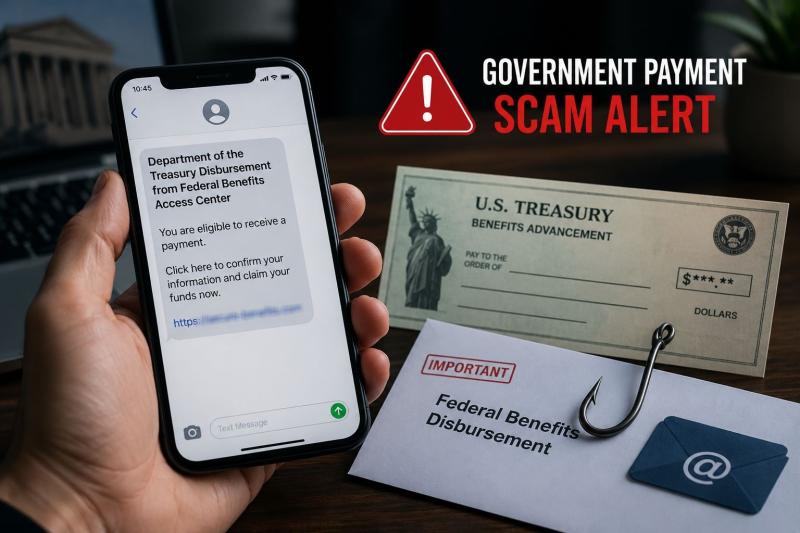
Many people trust messages that look like coming from government agencies, especially when they mention money, benefits, refunds, or official payments. Unfortunately, scammers often use this trust to create fake government related schemes. One example is the "Department of the Treasury Disbursement from Federal Benefits Access Center".
If you received a text message, email, phone call, or even a physical check claiming that you are eligible for a Treasury disbursement through the Federal Benefits Access Center, be careful. This is not a legitimate government program. The Federal Benefits Access Center is not an official federal agency, and these messages are commonly associated with government impersonation scams designed to steal personal and financial information.
In this scam, fraudsters pretend to represent a government organization and claim that you have money waiting for you. They may say that you are eligible for a benefit payment, government grant, Treasury disbursement, unclaimed funds, or another type of financial assistance.
The scam may arrive through different methods, including:
The goal is usually to convince victims to share sensitive information, click harmful links, pay unnecessary fees, or deposit fake checks. Real government agencies do not randomly contact people and ask them to provide personal details, pay fees, or follow suspicious links to receive benefits.
One major warning sign is receiving a message about money you were not expecting. Scammers often use attractive offers such as:
These messages create urgency and excitement so people act before checking whether the offer is real.
Scammers often create names that sound official to gain trust. The name "Federal Benefits Access Center" may sound like a government department, but it is not a recognized federal agency.
Fraudsters commonly use words like:
to make fake organizations look like legitimate ones.
A common purpose of these scams is identity theft. The scammers may ask for information like:
Government agencies already have secure processes for handling benefits and payments. They will not ask you to provide sensitive information through unexpected text messages, emails, or unofficial websites.
Another major red flag is being asked to pay money before receiving your supposed benefit. Scammers may request for:
Legitimate government benefits and disbursements do not require you to pay a fee to unlock your money.
Some victims receive physical checks that look real. The check may include phrases such as:
The scammer may instruct the victim to deposit the check and then send back part of the money, pay a fee, or contact a fake support number. However, these checks are counterfeit. Depositing a fake check can result in financial losses when the bank later discovers the check is not valid.
If you believe you may actually be receiving a government payment, do not use links or phone numbers provided in suspicious messages. Instead, verify information through official sources.
If you received a physical check claiming to be from the U.S. Department of the Treasury, you can verify it using the official Treasury Check Verification System. Do not deposit a suspicious check until you confirm it is genuine.
If you want to check whether you qualify for legitimate federal assistance, use official government resources such as the USA.gov Benefit Finder Tool. Avoid websites that claim to provide government benefits but request unnecessary personal details or payment.
People receiving legitimate federal benefits, including Social Security or other government payments, should manage their payments only through official services. For direct deposit and payment information, use trusted government supported services such as:
If you are unsure whether a payment is legitimate, contact the official Bureau of the Fiscal Service Call Center at 1-855-868-0151 rather than calling numbers provided in suspicious messages.
If you receive a message about a Department of the Treasury Disbursement from the Federal Benefits Access Center:
If you already shared information, monitor your financial accounts carefully and consider taking steps to protect your identity. You can also report the scam through official channels, including:
For suspicious Treasury related phishing emails, you can forward them to phishing@irs.gov.
Example 1: Fake Text Message:
A person receives a text saying:
"You have an approved Treasury benefit payment. Click this link to confirm your information."
The link leads to a fake website designed to collect Social Security numbers and banking details.
Example 2: Fake Check Scam:
Someone receives a check in the mail claiming to be a government benefit payment. They are told to deposit it and send back a small amount for processing.
The victim later discovers the check was fake and loses money.
Example 3: Fake Support Number:
A scam email provides a phone number for a Treasury representative. When the victim calls, the scammer pretends to verify their identity and asks for sensitive information.
The "Department of the Treasury Disbursement" from "Federal Benefits Access Center" is not a legitimate government payment program. It is a scam attempt that uses official looking language and fake government connections to trick people.
Always be cautious when receiving unexpected messages about money or benefits. Real government agencies do not pressure people through random texts, emails, or calls, and they do not require fees or personal information through unofficial channels.
Before trusting any government payment message, verify it through official government websites and contact information.
Disclaimer: The information in this article is provided for educational and awareness purposes. Company names, phone numbers, sender names, and other details referenced may have been impersonated, spoofed, or otherwise misused by scammers. Their appearance in this article does not necessarily identify the legitimate company, owner of a phone number or account as being involved in fraudulent activity.
This article has been written by a Scam Fighter Contributor, De-Reviews.com Team. If you believe the article above contains inaccuracies or needs to include relevant information, please contact ScamAdviser.com using this form.
De-Reviews.com Team is a group of scam researchers, editors, and online safety advocates dedicated to exposing online fraud and helping consumers stay safe online. The team has been investigating scams, fraudulent websites, phishing campaigns, and other online threats since 2014. Read the Full Author Profile.
